OEM boards and amplifier modules for strain gauges and temperature
7 products
Showing 1 - 7 of 7 products
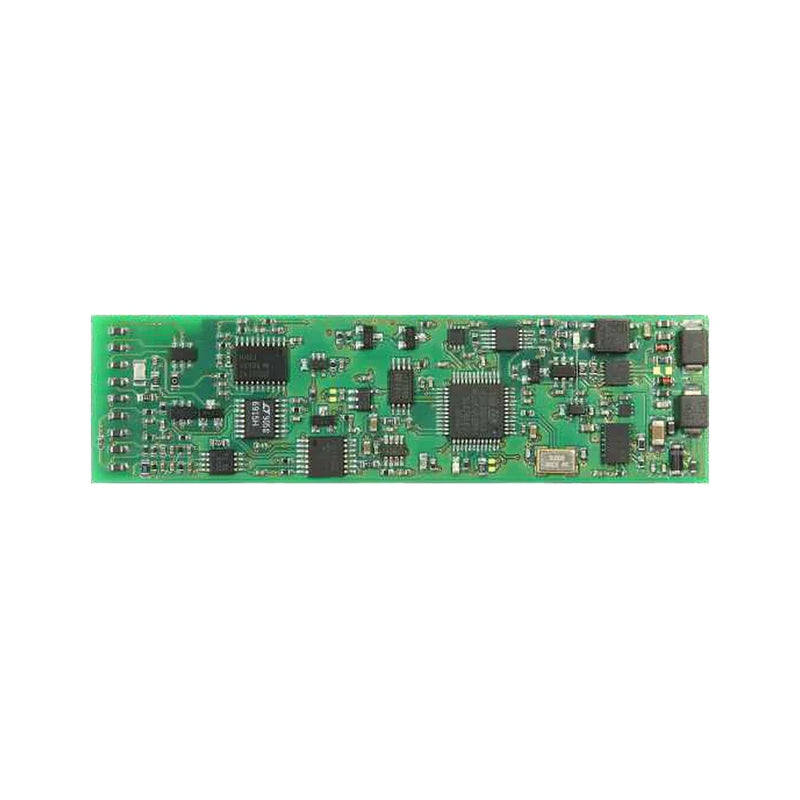
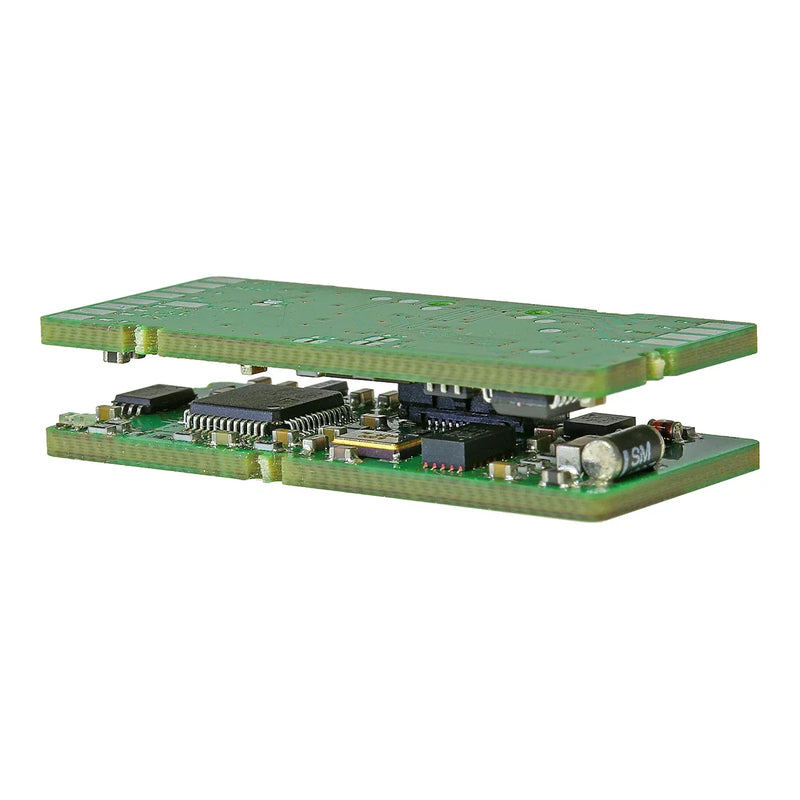
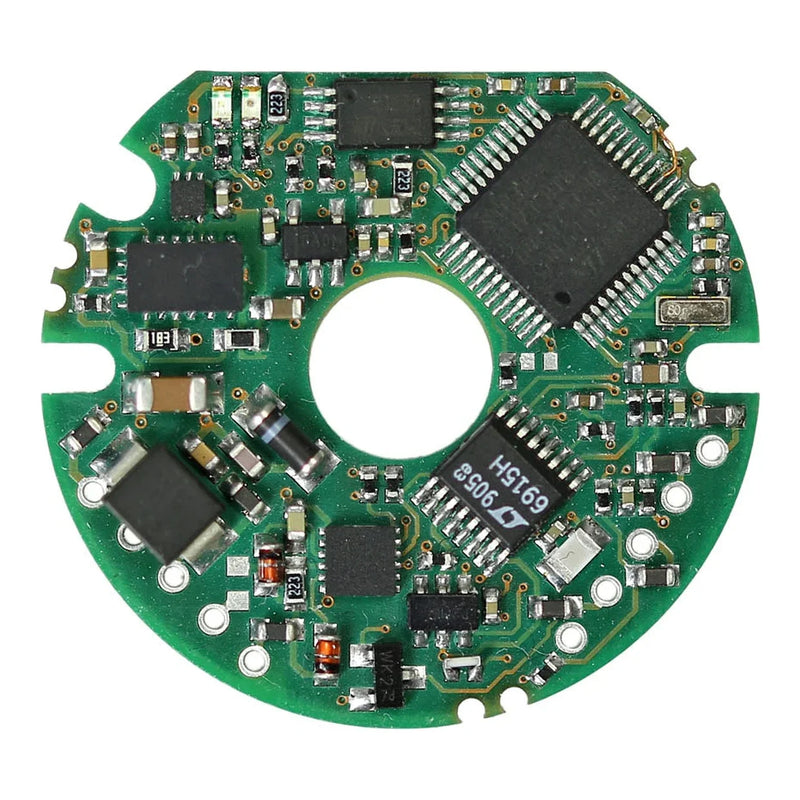
OEM boards and amplifier modules for strain gauges and temperature. Measuring amplifiers without a housing, for installation in your device, your control cabinet or your own sensor. For strain gauge full bridges as well as for resistance sensors and thermocouples, with analog or digital output and, on request, already scaled to your sensor.
OEM boards and amplifier modules for strain gauges and temperature: who this category is intended for
Nobody buys a measuring instrument here, but an assembly for their own product: machine and plant builders who integrate force or temperature measurement into their control system, sensor manufacturers who equip their transducers with an output signal, and manufacturers of test, laboratory and medical equipment.
Doing without the housing is the whole point, not the budget option. You do not need a second box next to your device, but electronics that fit into your existing mechanics: on a mounting plate in the control cabinet, in a sensor housing, behind a front panel or built directly into a cable.
OEM boards for strain gauge sensors
A strain gauge bridge delivers a few millivolts and needs a stable excitation. For integration, different parameters are therefore decisive than for a finished device.
- Input sensitivity in mV/V, matching the sensitivity of your sensor. Standard load cells are at 2 mV/V; directly bonded strain gauges and special transducers are sometimes considerably lower or higher.
- Bridge resistance and excitation, so that the board reliably supplies your bridge, even when several cells are connected in parallel.
- Four- or six-wire connection. If the board sits directly at the sensor, four-wire is sufficient. If the sensor cable runs through your device or is exposed to areas with changing temperatures, six-wire technology compensates for the cable resistance and prevents slow, temperature-dependent drift.
- Temperature stability of zero point and gain, specified in ppm per kelvin. These two values determine what the assembly actually achieves once installed – not the resolution in bits.
- Adjustment options, meaning zero point and full-scale value can be set via an interface instead of a potentiometer, so that nothing has to be adjusted by hand in your series production.
Matching sensors can be found under load cells and force transducers and in strain measurement. If measurement takes place directly on the component, we bond the strain gauges and supply the transducer and electronics matched as one unit.
OEM boards for temperature
With temperature, the complexity lies not in the amplification but in the sensor type and the linearization.
- Resistance sensor or thermocouple. Pt100 and Pt1000 provide a resistance, thermocouples a very small thermoelectric voltage. Each requires a different input stage; before you choose, clarify which sensors are installed in your device and whether it could be both in future.
- Two-, three- or four-wire connection. With Pt100 the cable resistance distorts the result considerably, because the measuring resistance itself is small. Two-wire is only usable with very short cables, three-wire is the usual compromise, four-wire the most accurate option. Pt1000 is much less sensitive to cable effects and is therefore often the smarter choice for simple wiring.
- Cold junction compensation. A thermocouple only measures the difference to the connection point. The board has to measure the temperature at this point itself and subtract it. Pay attention to where the compensation sensor sits and how the self-heating of your device affects it; this is the most common source of error with integrated thermocouple inputs.
- Linearization according to the respective characteristic curve, so that you get an output signal that is linear with temperature and do not have to calculate it yourself.
- Sensor break and short-circuit detection, so that your device reports a defect instead of outputting a plausible-looking false value.
The matching sensors can be found in our temperature range, finished devices under temperature transmitters.
What else counts in OEM procurement
Quantity and series price. For recurring demand we calculate volume prices and blanket orders. Tell us the annual quantity and you will get a calculation instead of a list price.
Long-term availability. A machine runs for ten years and longer, and your bill of materials should remain stable for as long. Clarify availability and discontinuation notice periods before you release an assembly for series production. This is the question that most often comes too late in purchasing.
Depth of documentation. For integration you need a dimensional drawing with hole pattern, connector pin assignment, supply and current requirements, temperature range, notes on shielding and grounding, and a 3D model. Whatever is not online for an item, we will send you.
Factory configuration. We supply the boards already scaled to your sensor. This eliminates the adjustment step in your production. In series production, this is often a bigger saving than the unit price.
Responsibility for conformity
A circuit board without a housing is not a ready-to-use device. CE conformity, EMC testing and, where applicable, the safety assessment apply to your end product and are therefore your responsibility. We supply the information you need for this: EMC-relevant notes, details of isolation and excitation, and recommendations on mounting position. For safety-related applications there are versions that allow a classification to SIL and Performance Level; the assessment is always made in the context of your overall architecture.
Three integration mistakes
Interference. Keep a distance from switched-mode power supplies, relays and frequency converters, route the sensor cable separately from power cables, and connect the shield at one end. With a millivolt bridge, the circuit board environment determines the achievable resolution.
Heat. The accuracy figures apply to the specified temperature range. If the board sits in a closed housing next to a power supply, the zero point drifts with temperature, and the error is later looked for in the sensor.
Mechanics. Use the intended mounting points, do not put the board under stress, and secure the connectors against vibration.
When no standard board fits
In OEM projects this is more the rule than the exception. We adapt existing assemblies – scaling, firmware, pin assignment, connectors, assembly variants or dimensions – and, if required, develop measuring electronics to your specifications.
Because we also design and manufacture sensors, bond strain gauges and calibrate to ISO 17025 in our own laboratory, you can obtain the complete measuring chain as a fully matched assembly: transducer and electronics, tested and documented, with one item number in your bill of materials.
Send us the measured variable, sensor type, required output, installation space and planned annual quantity, and you will get a concrete proposal.