Bluetooth transmitters for load cells and force transducers
1 product
Showing 1 - 1 of 1 product
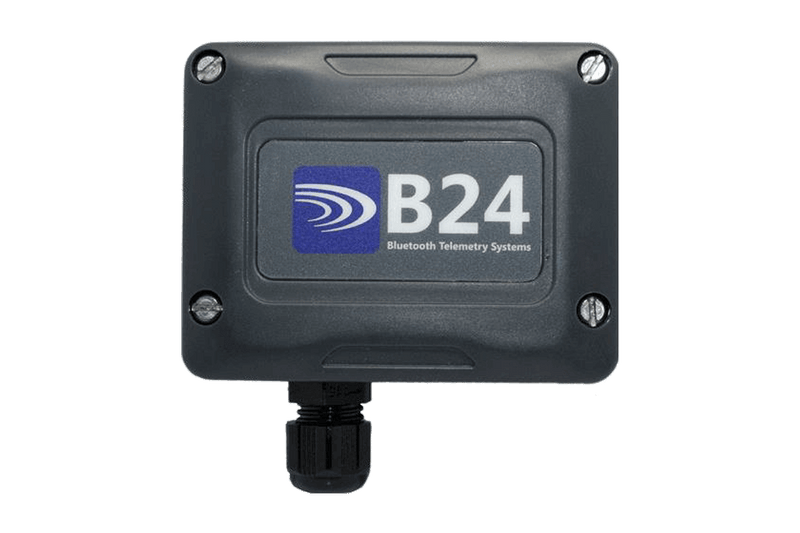
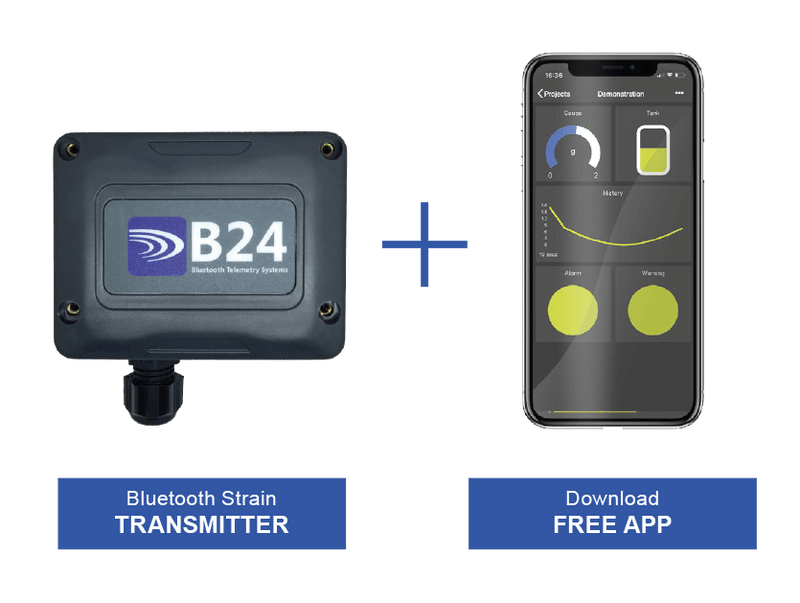
With Bluetooth transmitters for load cells and force transducers, your smartphone is the display device. A transmitter module at the sensor excites the measuring bridge, digitizes the signal and transmits it via Bluetooth Low Energy to a phone or tablet. No base station, no PC software, no approval from your IT department. On request we supply sensor and module connected and ready to use.
Bluetooth transmitters for load cells and force transducers: the difference from industrial wireless transmission
Bluetooth is not the newer version of wireless, but built for a different purpose. Four points distinguish the technologies.
The receiver is a device you already have.
With wireless telemetry, every transmitter needs a matching receiver, that is, a base station, handheld display or output module. With Bluetooth, the smartphone takes on this role. This considerably lowers the entry cost and makes the system ready for use immediately.
The range is limited, but greater than expected. With a clear line of sight, 30 to 90 m can be achieved, depending on the age and quality of the receiving device. Inside buildings, walls, steel structures and full vessels attenuate the signal considerably. Bluetooth therefore reaches across a weighing point or a loading zone, but not as far as the control room.
Battery life is the real advantage.
Two AA cells last around ten months in continuous operation at one reading per second, and in standby the consumption is in the microampere range. This makes not only handheld measurement possible but also long-term monitoring, for which conventional wireless telemetry would need a permanent power supply.
There is no connection to the plant.
Bluetooth provides no 4…20 mA signal, no relay contact and no fieldbus interface. If the value is to go into a control system, this is the wrong technology; in that case use a weight transmitter or a wireless system with an output module from our wireless measurement technology.
One point that decides the purchase in companies with a strict IT policy: Bluetooth needs no Wi-Fi access, no network approval and no firewall rule. The connection runs directly between the module and the end device.
What the app does
The app for iOS and Android is free of charge. It shows readings as a digital display, dial gauge, vessel graphic or chart, and from these you build your own dashboard with the level of detail your application needs. The modules are also configured and calibrated in the app; no laptop is needed.
The calculation function is particularly useful: displayed values can be defined as a mathematical expression from several transmitter modules, functions and constants. This lets you add up three load cells under a vessel to get the total weight, without installing a junction box and without cabling between the cells. Differences, averages and conversions into your own units are possible in the same way.
Bluetooth Low Energy also allows more than a point-to-point connection. One module can serve several receivers at the same time by broadcast, and one end device can display several modules. In practice this means several colleagues see the same value on their own phones, and one phone monitors several measuring points.
Which sensors can be connected
The modules work with strain gauge full bridges from 85 to 5000 ohms in 4-wire configuration. With several sensitivity ranges from ±6 to ±48 mV/V, they cover not only load cells with the usual 2 mV/V but also directly bonded strain gauges and sensors with a high sensitivity, for which conventional weighing electronics are set too insensitively.
This turns any existing load cell, any force transducer and any strain gauge installation on a component into a wireless measuring device. The temperature range of -40 to +85 °C also allows use outdoors and in cold storage, and the housed version is protected to IP67.
For sensor manufacturers and integrators
In addition to the housed version, the modules are available as a matchbox-sized OEM board that can be built into your own sensor housing. The advertising format and BLE services are documented, so you can integrate the module into your own app. If you want to equip your product with a Bluetooth interface without developing measuring electronics yourself, this is the fastest route. For the mechanical side, we can develop the matching custom transducer on request.
Where it pays off in everyday use
Service and maintenance. The technician arrives at the plant with a sensor and a phone, measures, documents and emails the report on site. No laptop, no cable, no setup.
Mobile inspections. Checking rope tension, testing lifting accessories, measuring tensile forces on guy lines. Wherever the measuring point is a different one every day.
Commissioning and troubleshooting. Reading values while standing at the machine instead of walking back and forth between the control cabinet and the measuring point.
Long-term measurement without infrastructure. Mount the module, set a low measuring rate, read out after months. No cable route and no power connection at the measuring point.
Measuring equipment that gets passed on. Separate PINs for configuration, display and calibration prevent settings from being changed unintentionally. If you lend devices or pass them on to customers, this protects the calibration while everyone can still read the value.
Ready to connect and calibrated
If you order a module together with a load cell or force transducer, we connect the sensor and module for you free of charge. On request we calibrate the measuring chain to ISO 17025 in our own laboratory, so you measure in kg or kN rather than in mV/V.
Alternatives
Mobile display devices without a smartphone can be found under handheld measuring devices, industrial wireless transmission with plant connection under wireless measurement technology, and measurements on rotating components under telemetry.
Our engineers will advise you directly on choosing the sensor, module and calibration.