Load Cells and Sensors with IO-Link Output
2 products
Showing 1 - 2 of 2 products
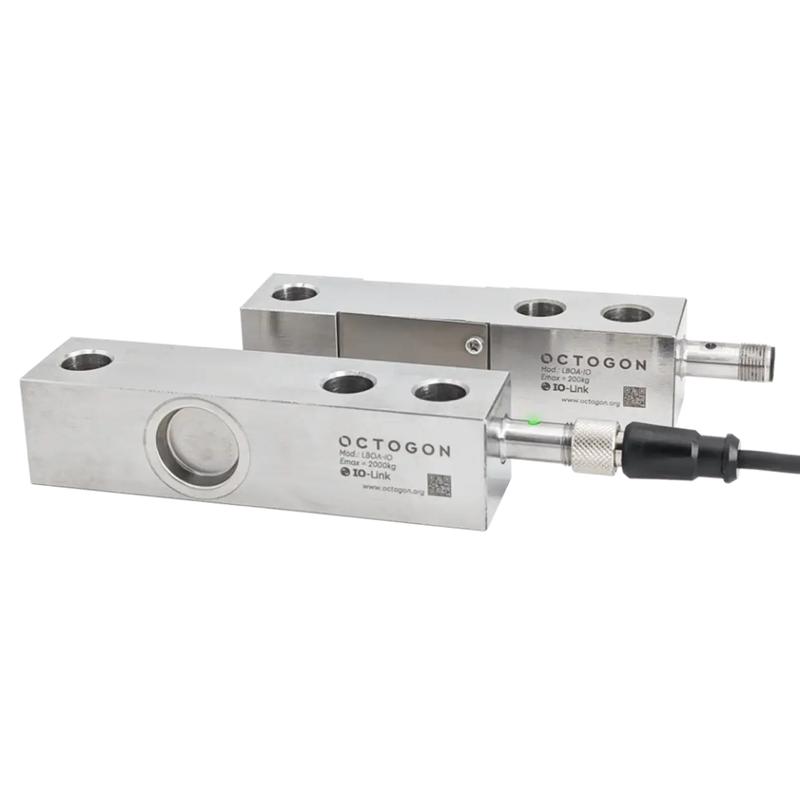
With load cells (as well as force transducers) and sensors, the measuring electronics are integrated into the sensor housing and provide an IO-Link output or interface. You receive a device with a cable or M12 connector, which delivers the measured value digitally and already in your unit. No separate amplifier, no millivolt line, no space required in the machine frame.
Load cells and sensors with IO-Link output: One device instead of two
A classic measuring chain consists of a sensor, measuring cable, and amplifier. With a sensor featuring integrated IO-Link, the middle component is eliminated. The bridge is directly powered and digitized within the housing, and the sensitive millivolt signal never leaves the sensor.
This results in four practical advantages.
No interference on the signal path. Between the measuring point and digitization, there are only a few centimeters instead of several meters of cable. Frequency converters, contactor circuits, and parallel power lines are therefore no longer an issue.
Fewer connection points. Every terminal and every connector is a potential source of error, especially with vibration and moisture. An integrated sensor has only one.
No space required for an additional module. In cramped machine frames, on grippers, and in fixtures, there is often simply no room for an additional housing.
Scaled and calibrated ex works. The sensor delivers Newtons, kilonewtons, or kilograms, not mV/V. We calibrate the entire measuring chain, upon request according to ISO 17025 in our own laboratory, and provide the protocol. During commissioning, you upload the IODD file, and the value is correct.
When a separate amplifier is better
The integrated design also has disadvantages, and you should be aware of them beforehand.
Retrofitting is not possible. An existing load cell cannot be made IO-Link compatible in this way. For this, you need an IO-Link measuring amplifier as a separate module.
The electronics share the sensor's environment. The permissible temperature range is determined by the electronics and is therefore lower than that of a pure strain gauge cell. Near ovens, in foundries, or in high-temperature applications, separating the sensor from the evaluation is the better approach, even with a remote amplifier.
In case of failure, you replace the entire device. With a separate design, you only replace the module if in doubt. With integrated electronics, the complete sensor is returned.
Delivery time. Integrated versions are usually built to order, while the cell and standard module may be in stock.
The rule of thumb: New designs, limited space, harsh environments, and series production favor the integrated solution. Retrofitting, high temperatures, and existing sensor technology favor the separate module.
Available designs
The IO-Link electronics can be integrated into our common designs, so you don't have to compromise on mechanics for the interface. Depending on the application, the following are suitable:
- S-type load cells for tension and compression in tension linkages and test setups
- Tension and compression force transducers for test benches and press monitoring
- Button and compression force load cells for flat installation situations and force measurement under supports
- Load pins for forces in bolt and joint areas
You can see which designs are currently available with integrated IO-Link in the product list above. If none of them fit your installation situation, we develop customized transducers with an integrated interface. Design, manufacturing, strain gauge application, and electronics are all handled in-house, which significantly shortens coordination times, especially for special designs.
Typical applications
Press and joining force monitoring, pressing with force-displacement evaluation, gripper and clamping force measurement in handling technology, force measurement on robots and end effectors, container and dosing weighing within machines, overload monitoring on fixtures, testing equipment in ongoing production.
Common to these cases is that the measuring point is located in the machine and the value goes to the control system, not to a display for the operator. This design is specifically made for such applications.
Fundamentals and Environment
How IO-Link works, what data is transmitted, and what device replacement with data storage offers can be found in the overview IO-Link sensors and measuring electronics and in detail on our page about IO-Link.
If the measured value is not intended for a control system but for a display for the operator, please refer to the weighing indicators; for long distances and bus or analog output, see the weighing transmitters.
Datasheet, IODD file, and CAD model are available for download with each item. Our engineers will advise you directly on the selection of design, nominal load, and scaling.