Weighing Indicators in Enclosures
6 products
Showing 1 - 6 of 6 products
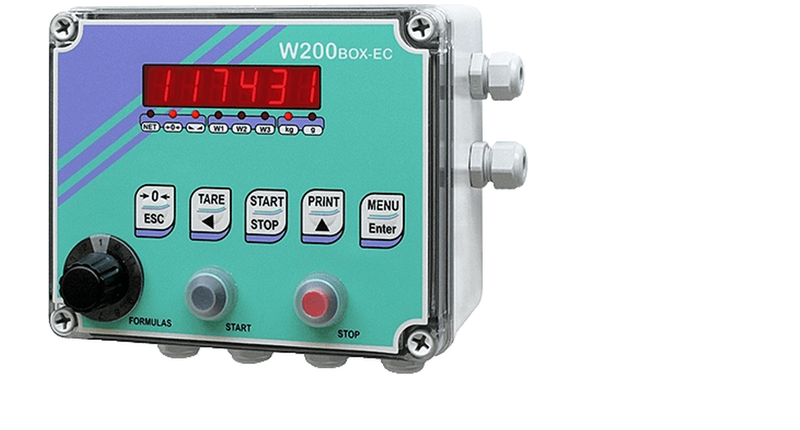
Weighing indicators in enclosures come with their own protection and do not require a control cabinet. Plastic enclosures with cable glands and protection class up to IP67, mountable on wall, column or table. The solution for wet areas, dusty environments and for retrofitting existing scales.
When weighing indicators in enclosures are the right choice
An enclosed device is useful wherever there is no control cabinet nearby or the environment overstrains a panel-mounted device. Typical examples: floor scales in the hall, weighing stations in shipping, filling stations in food production, stable areas in agriculture, retrofitted scales in a workshop.
The advantage over panel mounting is its self-sufficiency. You don't need a control panel or a cutout, just a wall or a column and the cable routes. Basic information on display, certification and dosing functions can be found in the overview of weighing indicators.
The protection class is only achieved during installation
IP68 or IP69k is a characteristic of the housing in the closed, correctly mounted state, not of the device in the box. In practice, most water ingress occurs at four points.
The cable glands must match the cable diameter. A cable that is too thin in a gland that is too large will not seal, even if the nut is tight. Unused openings should be closed with blanking plugs, not with adhesive tape.
Cable routing should be done from below or from the side with a loop below the housing. A tightly inserted cable from above will lead water directly into the gland.
The lid seal must be clean and undamaged, and all screws evenly tightened. After each opening for parameterization, a quick check of the seal is worthwhile.
Condensation occurs despite a sealed housing if the device undergoes temperature changes, for example in a refrigerated area or outdoors with night cooling. Moist air trapped when opened condenses inside. Therefore, do not mount in drafts or directly next to doors, and close the housing in a dry, warm environment if possible.
Count cable entries beforehand
Six cable glands may sound generous, but they are quickly occupied. Calculate what actually needs to go in: load cell cables, power supply, relay lines to valves or vibrators, bus line to the control system, possibly printer or external buttons. With multiple cells without a summing box, the demand multiplies.
Plan the load cell input separately from power and relay lines, ideally on the opposite side of the housing. Frequency converters and switching loads in the same cable bundle are a common cause of unstable displays.
Cleaning and material
Plastic housings made of polycarbonate and ABS are mechanically robust and designed for everyday industrial use, but react to certain cleaning agents. Solvent-based and highly alcoholic cleaners can cause stress cracks, which are initially only visible as fine haziness and later compromise tightness. Use mild, plastic-approved agents and avoid high-pressure jets directly on seals and glands.
When installing outdoors, also check UV exposure and protect the device from direct sunlight, as the housing heats up and the display becomes less readable.
Mounting and operating height
When drilling, pay attention to the specified hole distances and mount the device at operating height, approximately 1.4 to 1.6 m, with the display tilted slightly towards the operator or in the line of sight. A membrane keypad can also be operated with gloves, which is the decisive factor in refrigerated and wet areas.
If the operator is further away or on a forklift, add a large display instead of looking for a larger indicator.
Matching components
Sensors can be found under load cells and force transducers, suitable sub-constructions under weighing platforms, and complete systems under complete scales. If it's just about transferring to a control system without on-site operation, a weighing transmitter is more economical.
Price, data sheet and CAD model are available online for each item. Our engineers will advise you directly on the selection of housing, protection class and cable planning.