Multi-axis force sensors and force-torque sensors
1 product
Showing 1 - 1 of 1 product
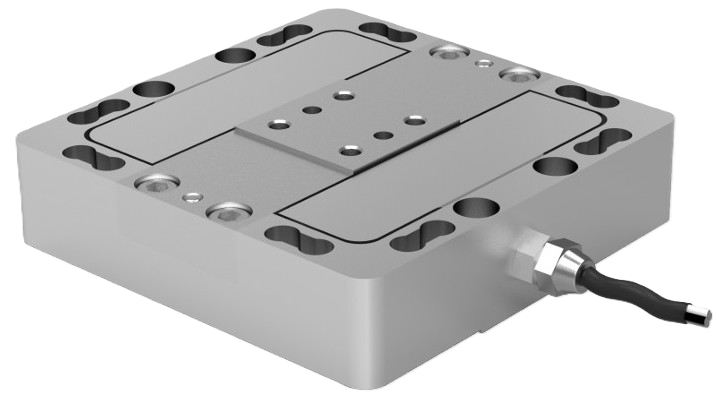
The multi-axis force sensors and force-torque sensors from octogon capture forces in two or three spatial directions and, depending on the design, the moments about these axes as well. Rated forces from 50 N to 1,000 kN per axis, stainless steel or aluminum, protection rating up to IP68. Each axis is calibrated individually, and crosstalk is documented in the calibration certificate. Custom force transducers are of course available on request.
Forces and moments in several axes with one transducer
A single-axis transducer measures only in its measuring direction. If the force acts at an angle, or if side forces and moments are also present, they distort the measurement or load the sensor beyond its limits. A multi-axis force sensor instead resolves the load into its components: Fx, Fy and Fz for the forces, Mx, My and Mz for the moments. This gives you not only the magnitude but also the direction and point of application of the load.
Several names are common for the same family of components: multi-component transducer, force-torque sensor, multi-axis load cell, multi-dimensional force transducer, or 2-, 3- and 6-component sensor for short. They all mean the same construction: several strain gauge full bridges in one body, evaluated independently of each other.
2, 3 or 6 components: which version fits
- 2-axis force sensors (Fx, Fy or Fz and one transverse component) are sufficient when the load acts in one plane, for example with web tension at a changing wrap angle or with guiding forces on linear axes.
- 3-axis force sensors (Fx, Fy, Fz) are the most common choice when the direction of the force in space is unknown or variable: contact forces on tools, foot forces, cutting forces at the spindle.
- 6-axis force-torque sensors (Fx, Fy, Fz, Mx, My, Mz) are needed as soon as the point of application or a tilt also matters. Typical uses are on the robot flange, in joining processes, and in chassis and component testing.
The selection criterion is the rated force per axis, not the sum. In many designs Fz can take a considerably higher load than Fx and Fy. So check the weakest axis against your largest load case, including the moments caused by the distance between your load introduction and the sensor center.
Crosstalk and calibration matrix
No multi-axis transducer is completely decoupled. A force in x always produces a small signal in the other channels as well. We measure this crosstalk and supply it as a matrix: your evaluation uses it to convert the raw signals into the actual components. Without this matrix, multi-axis measurements retain a systematic error that can reach several percent depending on the design. On request we calibrate to ISO 17025 in our own laboratory, also axis by axis for your specific load case.
Typical applications
Robot and cobot end effectors for force control, assembly and joining; test rigs with multi-axis load introduction; cutting force measurement on machine tools; biomechanics, force plates and orthopedics; chassis, tire and component testing; wind tunnel and flow measurement; grip and operating force analysis in ergonomics.
Signal processing
Each axis needs its own measuring channel. Our multi-channel strain gauge amplifiers are suitable for the connection, and devices from the rest of our measuring electronics range convert the signals to 4…20 mA, 0…10 V, IO-Link or fieldbus. For dynamic measurements, make sure all channels are sampled synchronously, otherwise the time offset distorts the calculated force vector.
Compared with single-axis transducers
If the direction of the force is fixed by the design, a single-axis transducer is more accurate and less expensive. For that, take a look at the tension and compression force transducers, and for pure moments the torque sensors. If no standard design fits your installation space or your combination of axes, we develop custom force transducers based on our standard bodies.
A data sheet and 3D data are available for download with every item. Our engineers will advise you directly on the design of the load introduction and the channel assignment.