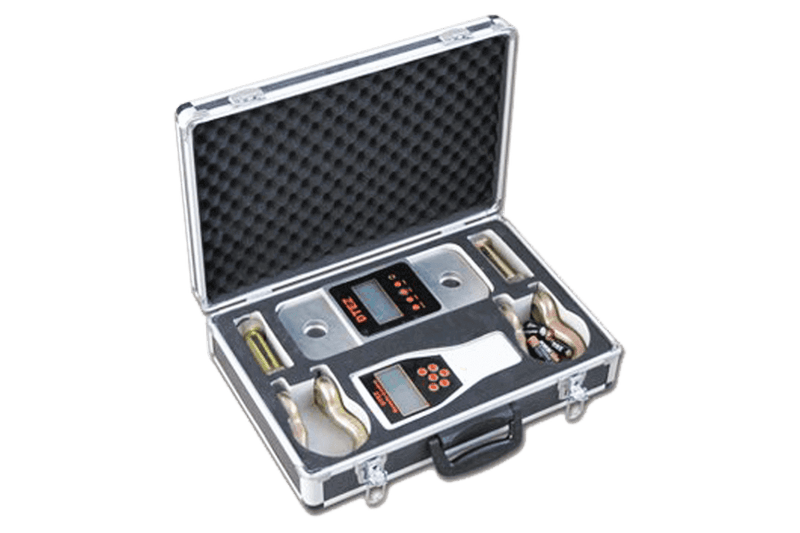
Crane scales from 50 kg to 30 t, legal for trade
3 products
Showing 1 - 3 of 3 products
Crane scales from octogon weigh loads exactly where they are suspended: between the crane hook and the lifting gear. Weighing ranges from 50 kg to 30 t, digital display directly on the device, with remote control depending on the model, legal-for-trade version for billing and commerce. The LGLA is supplied ready for use with shackle and hook.
Crane scales - weighing and lifting in one step
A crane scale, also known as a hanging scale or hook scale, is suspended between the crane hook and the load. This eliminates the need to move to a floor scale and enables weight control wherever no fixed scale is available: during loading, in goods receiving, at the press, in scrap yard operations, or for batch control in the foundry.
There are two designs. The classic digital crane scale features a display and electronics in its own housing, with the value read directly on the device or via a remote control. The hook-on radio load cell dispenses with its own display and transmits the signal to a handheld display device, which is the more practical solution for large reading distances, high loads, and measuring cable and pulling forces. This category contains the digital crane scales; for wireless transmission directly from the sensor, see wireless measurement technology.
Does the crane scale need to be verified?
This is the question that must be decided before purchase, as it determines the model. As a rule of thumb: as soon as the weighed weight is the basis for a price, an invoice, or an official quantity, you need a verified scale with a declaration of conformity according to Directive 2014/31/EU. This applies, for example, to scrap and metal purchasing, waste disposal, sales by weight, and customs processing.
If the scale is only used for internal control—i.e., overload protection, crane capacity utilization, batch testing, or freight preparation—a non-verified industrial scale is sufficient. These are significantly cheaper and more flexible in use because there is no requirement for subsequent re-verification.
Verified scales are subject to a re-verification period and must be re-verified at fixed intervals by a competent authority. When comparing, note the difference between "verifiable" and "verified": verifiable means the device meets the requirements and can be verified. Initial verification is carried out separately. We will clarify which variant you need in a discussion before you order.
Selection in four steps
1. Weighing range with reserve, but not too large. Include the dead weight of shackles, chains, spreader beams, and containers in your calculation. At the same time, readability depends on the weighing range. A 30 t scale displays in coarse increments; if you want to check 400 kg loads, the results will be unacceptably imprecise. Choose the smallest scale that can safely carry your maximum load.
2. Check installation height. The crane scale sits in the load path and consumes lifting height. In halls with limited clearance under the crane girder, the installation height between the attachment points is often the deciding factor, not accuracy.
3. Define the readout. Digit height and reading distance go hand in hand: 20 mm digits can be read from a few meters away; at a distance of 10 m or if viewing from above, you need a remote display or a handheld device. Models with printers are available for receipts and logs.
4. Functions according to process. Tare for net weight from containers, hold to freeze the value for oscillating loads, peak for the maximum load, summation for batches from multiple lifts, automatic shutdown to save battery life.
Safety and testing
A crane scale becomes part of the load-handling equipment and must be treated accordingly. Never load it beyond the specified capacity, not even briefly when pulling a stuck load. Use only the associated or approved shackles and hooks, check the safety latch on the hook, and ensure that the load is hanging freely and not pulling sideways. Like other load-handling equipment, the crane scale is subject to regular inspection by a qualified person; the intervals are determined by your risk assessment and national regulations.
Typical applications
Incoming and outgoing goods in the warehouse, scrap and recycling companies, foundries and steel construction, big-bag and container weighing, construction sites and yards, port and transshipment operations, agriculture, testing of cable and tensile forces on cable cars, masts, and guying systems.
Calibration and alternatives
Even scales that are not subject to mandatory verification should be checked regularly so that the values remain reliable. We provide ISO 17025 calibration in our own laboratory and issue the corresponding protocol.
If your load is not suspended from a crane, other designs may be more suitable: weighing platforms and floor scales for fixed weighing stations, cable tension load cells and tension link load cells for cable forces, weighing modules for installation under containers and silos. For special cases, such as particularly low installation heights or fixed integration into a crane system, we develop customized solutions.
Data sheets, prices, and delivery times are available online for every item. Our engineers will advise you directly on the selection of weighing range, verification variant, and lifting gear.