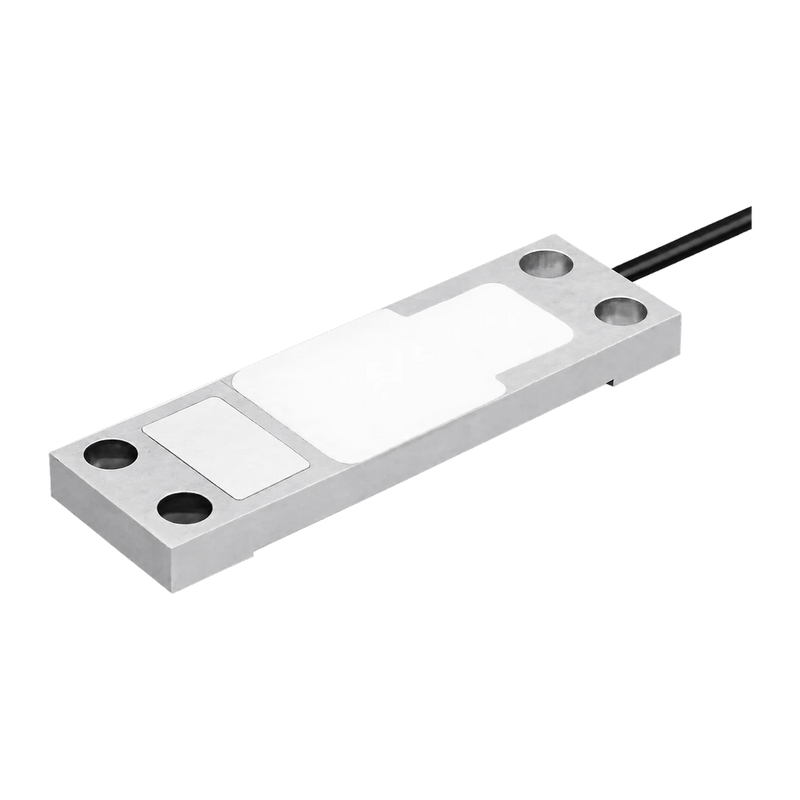
Bolt-On Strain Transducers for Large Equipment
1 product
Showing 1 - 1 of 1 product
Bolt-on strain transducers turn the component itself into the sensor. They are screwed onto the machine and read the strain of the part they sit on – where no load cell fits, or where nobody wants to cut the force path open.
When the transducer beats the load cell
- The force path stays closed. A load cell has to be built into the load path; the strain transducer is bolted on from outside.
- For large equipment. Presses, frames, columns, cranes: where the forces are too great or the parts too bulky for a load cell.
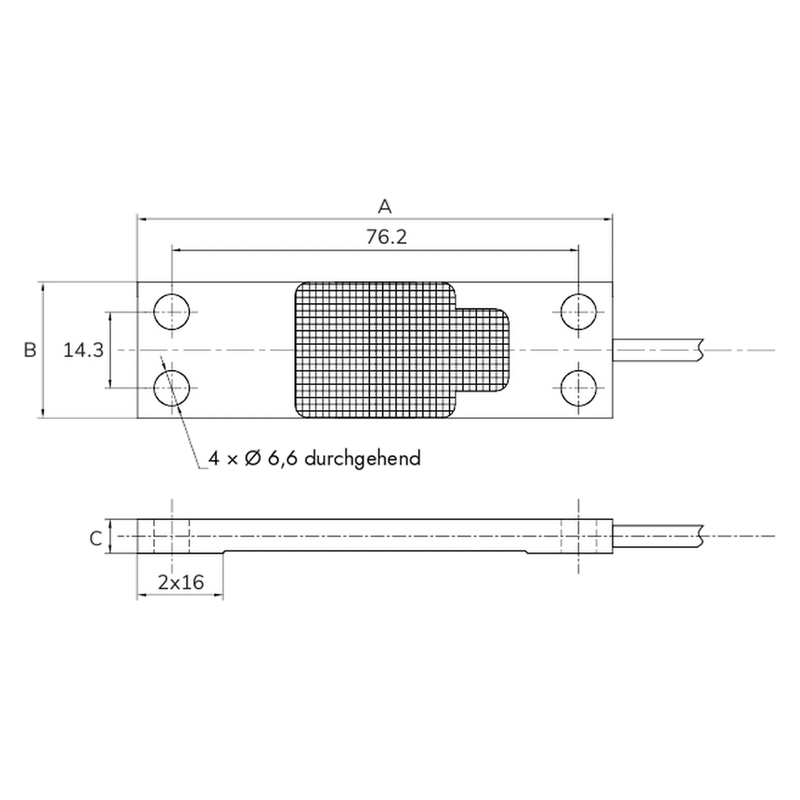
- Confined mounting spaces. Where no other force transducer has room, a flat face for four holes is enough.
- Replaced without touching the mechanics. Undo four screws, change the transducer – nothing about the structure changes.
- Permanently mounted. Unlike a clamp-on sensor, the transducer stays at its measuring point, sealed to IP65.
Key figures
- Capacities 200, 500, 1000 and 1500 µε
- Rated output 1.0 mV/V, full bridge, 5 to 10 V DC excitation
- Combined error ≤ ± 1.41 % of rated output; linearity, hysteresis and repeatability ± 1 % each
- Safe overload 120 %, ultimate load 150 % of rated output
- Stainless steel body 89 × 25.4 mm, four through holes Ø 6.6 mm
- Operating temperature −20 to +80 °C; a high-temperature version up to 250 °C is available on request
- Six metres of fixed cable, factory calibration included
What you need with them
The transducer is passive and works with any strain gauge amplifier – see strain gauge bridge amplifiers and OEM boards. Calibration to ISO 17025 is available as an option.
If strain is only to be read briefly and the measuring point moved afterwards, clamp-on strain sensors are the quicker route – they need no drilling. Strain measurement & strain gauges gives an overview of both routes.
Not sure which capacity suits your component? Tell us the material, the cross section and the load you expect – we will work it out with you.