Single-channel weight transmitters for load cells
3 products
Showing 1 - 3 of 3 products
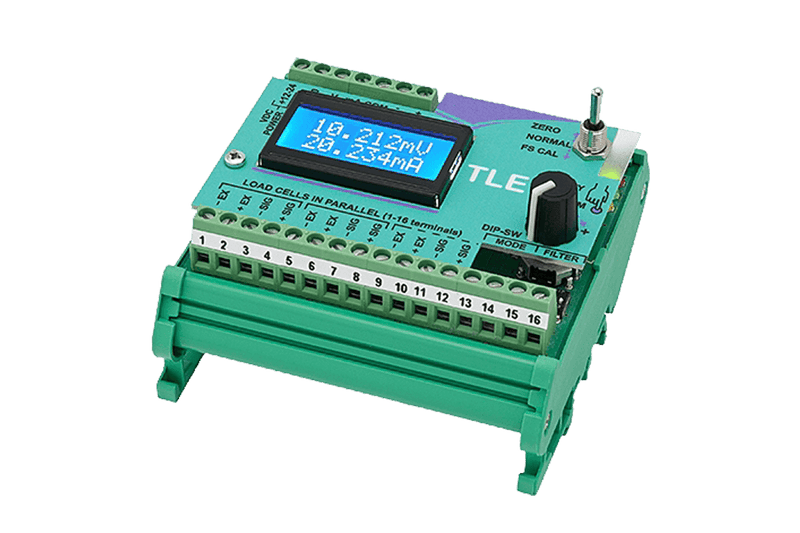
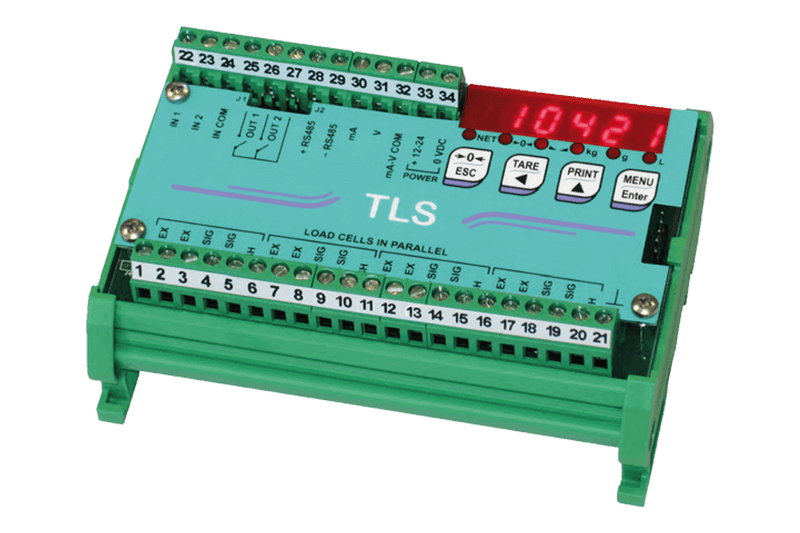
Single-channel weighing transmitters for load cells have one load cell input and evaluate one weighing point. Multiple cells under a container or platform are combined in a summing box and transmitted as a single signal. This is the most cost-effective solution and sufficient for most systems.
When is a single-channel weighing transmitter for load cells sufficient?
One channel is always sufficient when you need a weight value and don't need to know where it comes from. This applies to the vast majority of applications: container and silo scales with fixed load distribution, platform and floor scales, roller conveyors, retrofits to existing scales with an existing junction box.
Only if you need to monitor each cell individually or electronically balance the corner load is it worthwhile to opt for a multi-channel device. The required interface and sampling rate are independent of this; more information can be found in the overview of weighing transmitters.
Multiple load cells on one input
Three or four cells under a container are connected in parallel in a summing box. The box combines the bridges and provides a sum signal that corresponds to the total weight. Two points need to be considered.
First, the bridge resistance. Parallel-connected cells put a greater strain on the transmitter's supply voltage because the total resistance is divided. Each transmitter specifies a minimum permissible value; check the datasheet to see how many cells of your series it can supply before planning. If more cells are used than permitted, you will need a box with its own power supply or a second device.
Second, corner load adjustment. Because all cells are evaluated together, the transmitter cannot compensate for differences between them. For platform scales where the load rests at varying points, the adjustment is therefore carried out in the summing box using trim potentiometers. This is generally not necessary for containers with uniform load distribution.
Suitable summing boxes and junction boxes can be found in the accessories for load cells.
Connecting 4-wire or 6-wire
For short cables, a 4-wire connection is sufficient. If the cable is longer or located in an area with fluctuating temperatures, the resistance of the supply lines will distort the result, and this will be temperature-dependent, which will manifest as a slow drift during operation. The 6-wire connection with additional sense lines measures the supply voltage directly at the cell and compensates for this error. If your transmitter and cell support it, use it; extensions should always be implemented using 6-wire technology.
Route the load cell cable separately from power lines and ground the shield at one end. Frequency converters and contactor circuits in the same cable tray are one of the more common causes of unstable readings.
What else you need
The appropriate sensors can be found under load cells and force transducers, and the installation kit for containers under weighing modules. If an operator needs to read the value, a weighing indicator is a better choice than a transmitter in the control cabinet.
Price, data sheet, and CAD model are available online for each item. Our engineers will advise you directly on the design of summing boxes, number of cells, and cabling.