
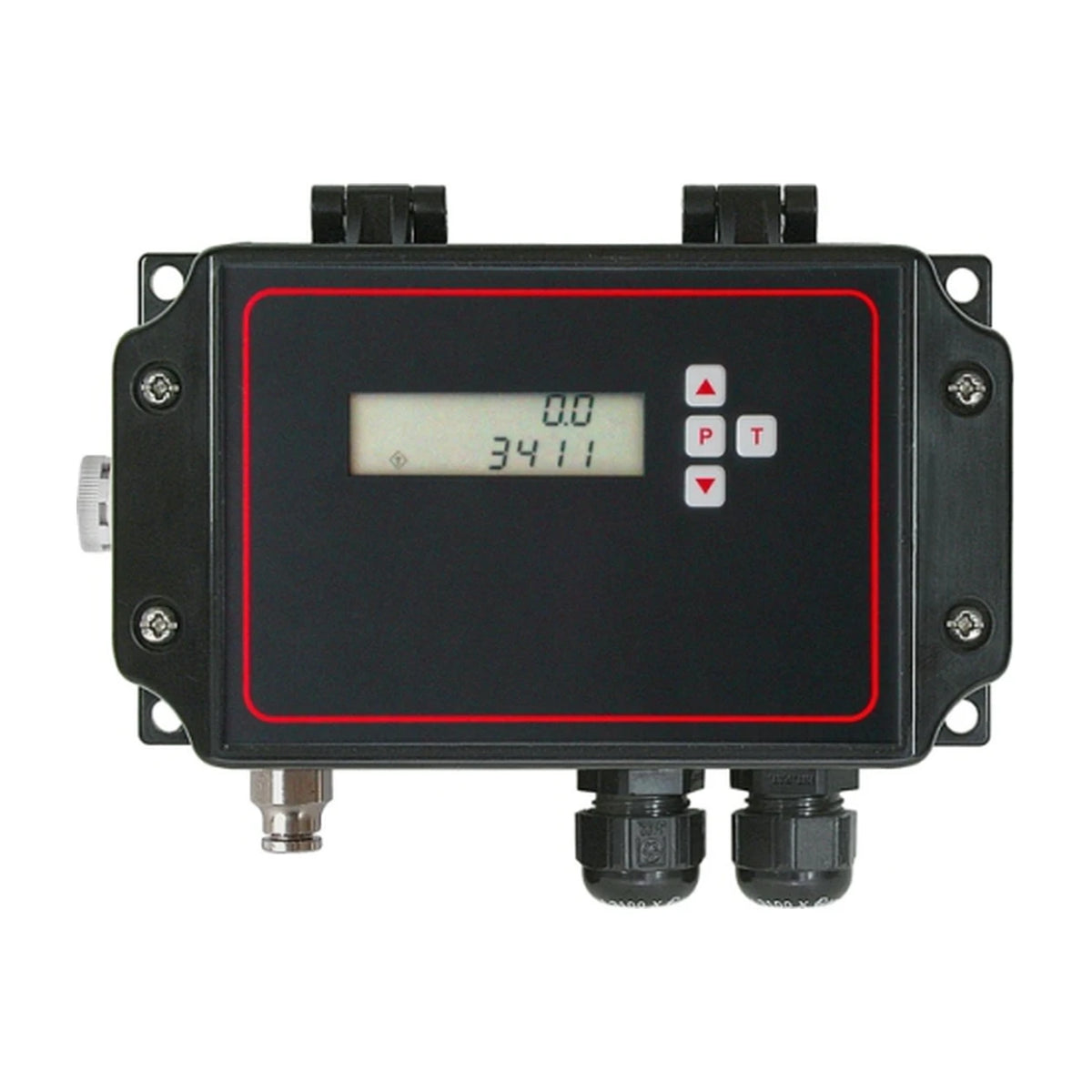


Description
A hose pump builds up a pressure in a bubbling-through tube. At the bevelled end of the tube air escapes as soon as the hydrostatic pressure is reached — density times filling height — and exactly that pressure stands in the tube, where the sensor reads it. The sensor itself never touches the medium, which is the advantage over a diving probe and the reason aggressive and abrasive media are no problem; foaming has no influence either, unlike with ultrasonics, and no connection below the tank is needed. The bubbling point may be up to 50 m away. The transducer gives 4 … 20 mA and 0 … 10 V at once, shows the value on an LCD display with four keys, and carries an RS232 interface; CANopen or Profibus are available as options. Twenty calibration points linearise irregular tank shapes into a volume. The housing is either die-cast aluminium or plastic, both IP65.
Measurement and output
- Positive relative pressure, hydrostatic
- Sensor 0 … 50 … 1000 mbar, five ranges
- Output 4 … 20 mA and 0 … 10 V at once
- Combined error ± 1 % of full scale
- Resolution 12 bit, TC < 50 ppm/K
- 20 calibration points for the volume
- LCD display and four keys
- RS232; CANopen or Profibus optional
Device and mounting
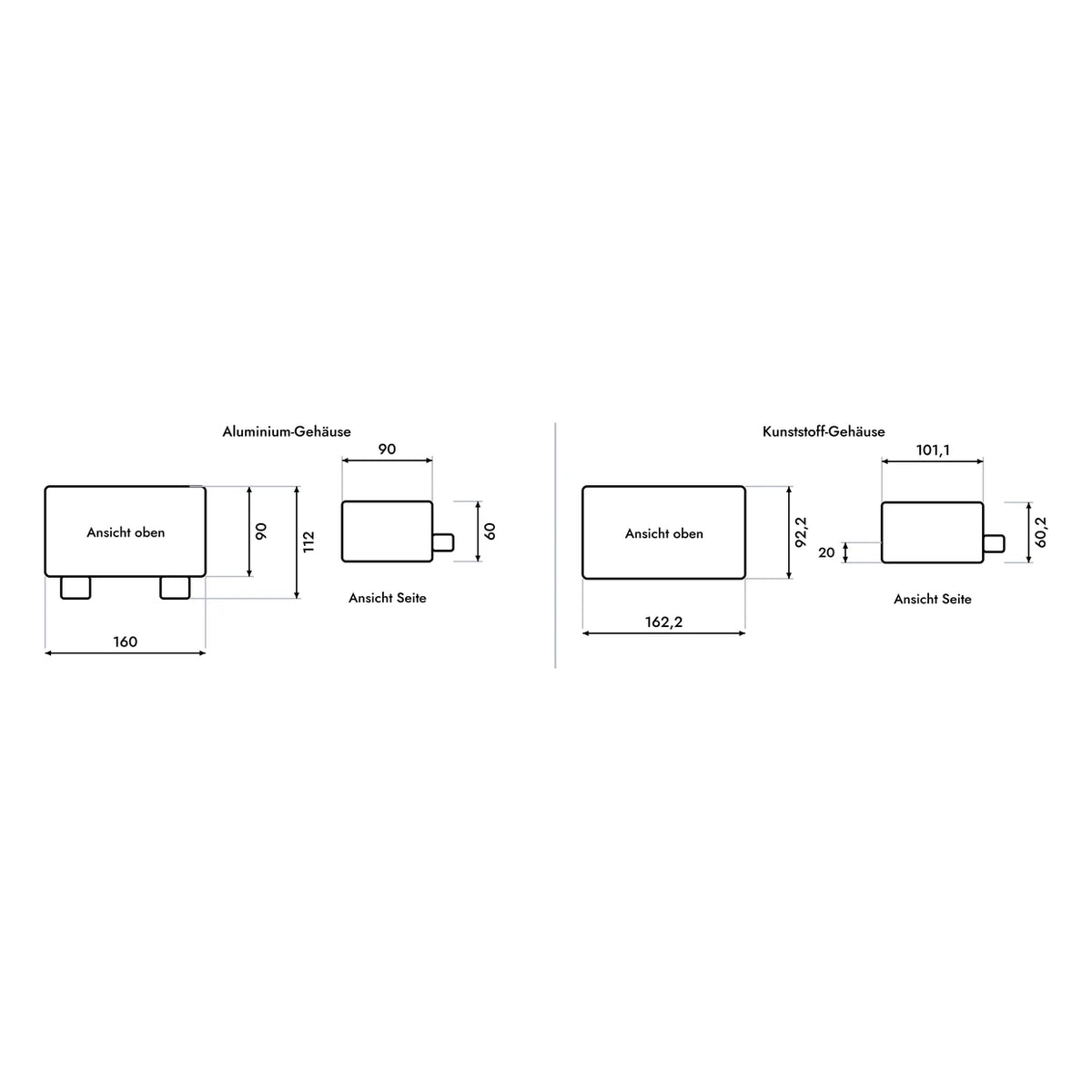
- Casing aluminium 160 × 90 × 60 mm, 1.1 kg
- Or plastic 162.2 × 92.2 × 60.2 mm, 0.7 kg
- Protection class IP65, EMC coating optional
- Pressure connection for 6 mm plastic tube
- Two cable glands M20 × 1.5, terminals to 2.5 mm²
- External pump fed with 24 V DC, 250 mA
- Bubbling point up to 50 m away
- Operation −10 … +60 °C, supply 24 V DC
All technical data, dimensions and available versions are listed in the datasheet for download.