


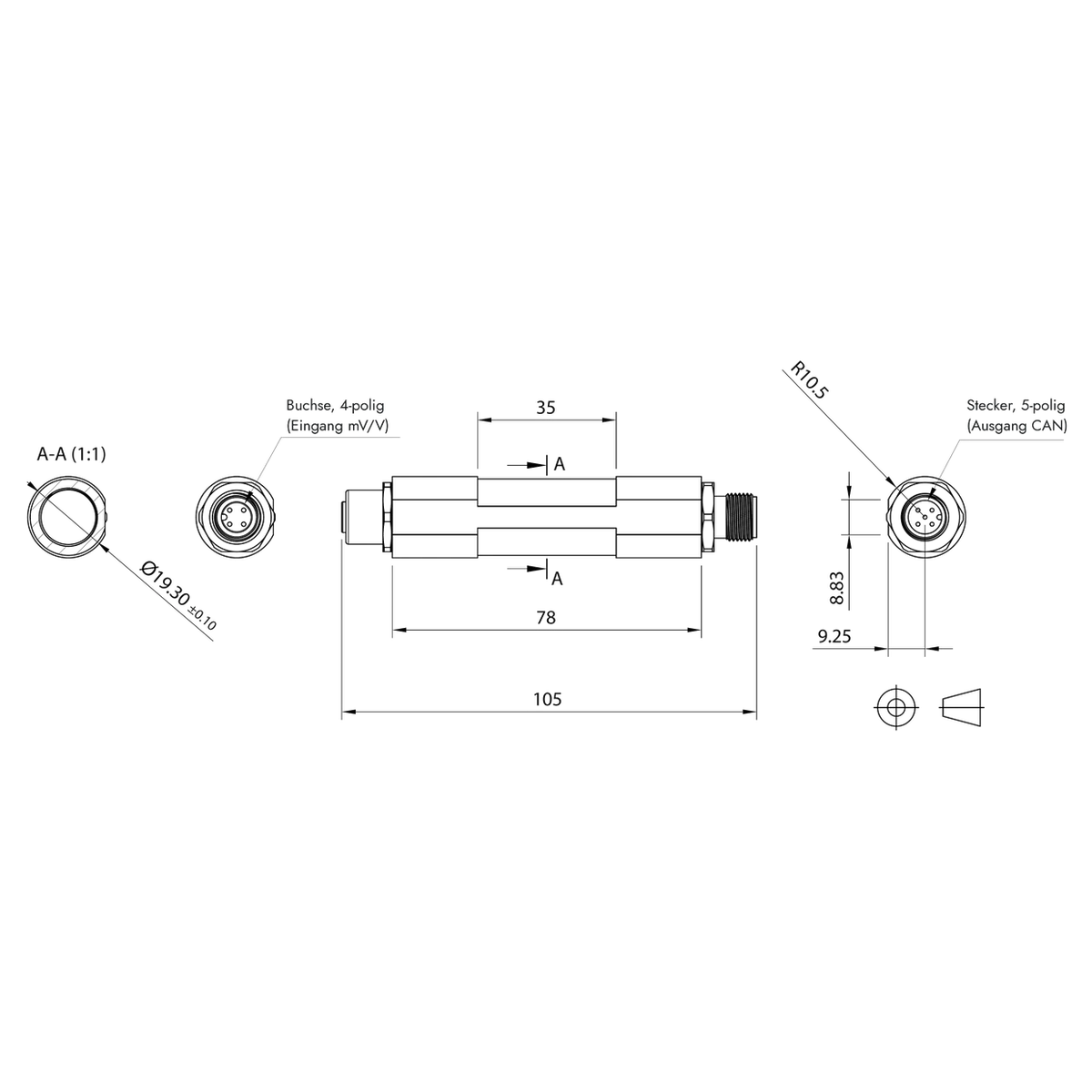


Description
The EMFA is a CAN inline adapter for load cells: it sits directly between an analog strain gauge load cell and the CAN bus, excites the load cell with 5 V DC, converts its mV/V signal and outputs the measurement as a CANopen or J1939 data stream. This turns an existing analog load cell into a node on the vehicle or machine bus without a separate amplifier in the control cabinet, for example on agricultural machinery, cranes and hoists, robots, refuse collection vehicles and tipper trucks.
It connects one strain gauge load cell with ±3 mV/V and a bridge resistance of 87.5 … 1,100 Ω, for example one cell of 350 Ω or four cells of 350 Ω in parallel. The A/D converter works with 24 bits, filtering is either IIR or averaging. Via CANopen it supports 10 … 1000 kbit/s and measuring rates up to 2.5 kHz, via J1939 250 kbit/s and up to 1.6 kHz. The bus termination is switched on over the bus, and the adapter detects a connected load cell by itself. It is powered with 9 … 36 V DC through the CAN connector and set up with a terminal program or the FDC application.
Both ends are M12 connectors: a 4-pole socket for the load cell and a 5-pole plug for bus and supply. The stainless steel 17-4PH housing is sealed to IP67, measures Ø 21 × 105 mm and weighs approx. 120 g. The operating range is −20 … +70 °C, storage −40 … +125 °C. The EMFA carries the CE marking and is RoHS compliant.
Benefits at a glance
- Turns an analog load cell into a CAN node
- CANopen (up to 1000 kbit/s, 2.5 kHz) or J1939 (250 kbit/s, 1.6 kHz)
- 1 strain gauge load cell, ±3 mV/V, 87.5 … 1,100 Ω
- 24-bit A/D converter, IIR or averaging filter
- Bus termination selectable over CAN
- Detection of the connected load cell
- Supply 9 … 36 V DC through the bus connector
- M12 socket 4-pole (in), M12 plug 5-pole (out)
- Stainless steel 17-4PH, IP67, Ø 21 × 105 mm, approx. 120 g
- Operation −20 … +70 °C, for vehicles and harsh industrial environments