Panel Mount Weighing Indicators
2 products
Showing 1 - 2 of 2 products
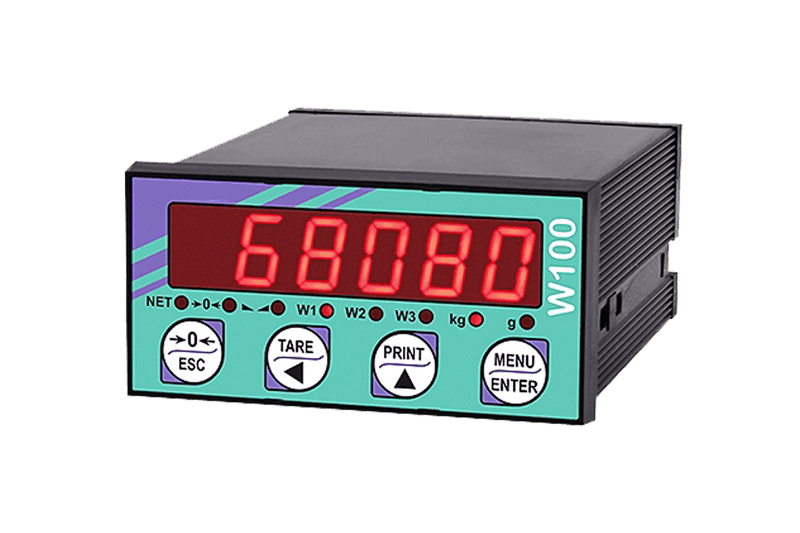
Panel-mount weighing indicators are installed in control panels, operator consoles, or control cabinet doors. The DIN sizes 96 x 48 and 96 x 96 mm fit into standardized cutouts and thus usually also into existing ones when an older display unit is being replaced. Protected on the front, designed for wiring in the cabinet on the back.
When panel-mount weighing indicators are the right choice
Panel mounting is suitable if an operator console or control cabinet is already available and the scale is part of a system operated there. The indicator integrates with the other displays and controls, all cables remain inside the cabinet, and the front stays tidy.
Two scenarios particularly favor this category: the construction of a new control panel, where you can freely plan the cutout, and the replacement of a defective or outdated device in an existing cutout. If no cabinet is available or the environment is wet and dusty, a device in an enclosure is the appropriate choice. General information on display, certification, and dosing functions can be found in the overview of weighing indicators.
Format and cutout dimension
The enclosures comply with the DIN standard series for panel-mounted devices. The 96 x 48 mm format is the narrow version for consoles with limited front space, while 96 x 96 mm offers more room for the keypad and status LEDs, making it more comfortable for operators.
The critical factor for purchase is not the front dimension, but the cutout dimension in the panel, which is slightly smaller because the frame overlaps the edge. The exact specification is provided in the data sheet for each item, and the CAD model is available for download. When replacing a device, measure the existing cutout instead of inferring the format from the old built-in device.
Do not underestimate the installation depth
The housing depth is only part of the space requirement. Behind the device, you also need additional space for the plug-in terminals and the bending radius of the cables. Therefore, calculate with significantly more than the datasheet depth, especially in shallow consoles and in control cabinet doors, where the device can collide with terminal blocks or cable ducts when closing. Check the door clearance before drilling, not afterwards.
Protection class and sealing
For panel-mount devices, the front plate is specified, with IP54 being common. This only applies to the visible side; the rear with the terminals is unprotected and must be located within the cabinet or console. For wet areas, this means either a sufficiently sealed console or a device in its own enclosure.
For the front seal to be effective, the panel around the cutout must be flat and the clamping brackets tightened evenly. Overtightening distorts the frame and lifts the seal in some places, which worsens rather than improves protection.
Heat and interference in the control cabinet
LED displays and power supplies generate heat, and in the cabinet, it rises. Observe the permissible ambient temperature, leave space between multiple devices, and do not mount the indicator directly above frequency converters or transformers. A device that sporadically shows errors in summer often has a thermal, not an electronic, problem.
Route the load cell cable shielded and separate from power lines, with the shield grounded at one end. For multiple weighing points in one console, it is worthwhile to plan the arrangement of devices and cable routes together.
Consider usability
Panel-mount devices have compact membrane keypads with few buttons. This is sufficient for displays, taring, and simple setpoints. If operators regularly switch between recipes or work with gloves, a larger device in an enclosure is more comfortable. If the value needs to be readable from a distance, add a large display.
If no one needs an on-site display and the value only goes into the control system, a weighing transmitter on the DIN rail is the more compact solution and saves the cutout.
Matching Components
You can find the sensors under load cells and force transducers, the rest of the product range in measurement electronics, and information on fieldbuses on our fieldbus page.
Price, data sheet, and CAD model are available online for each item. Our engineers will advise you directly on the selection of format, installation depth, and wiring.