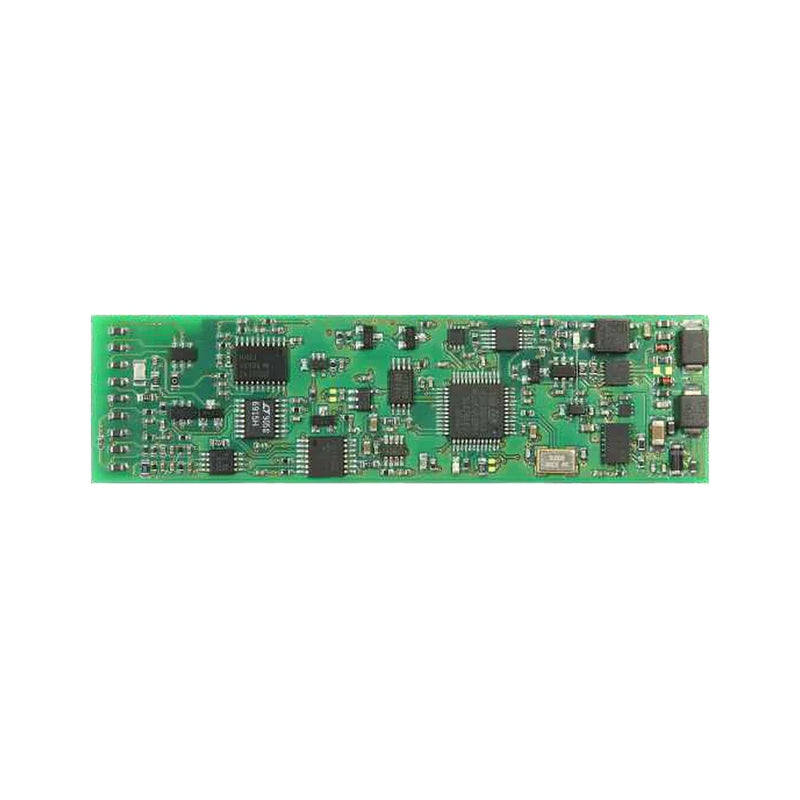
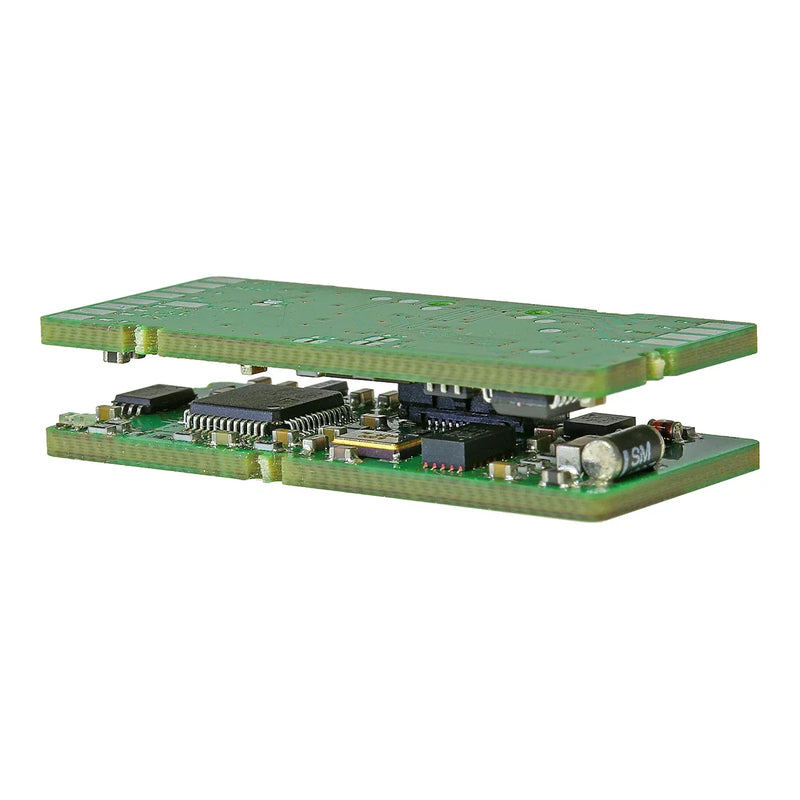
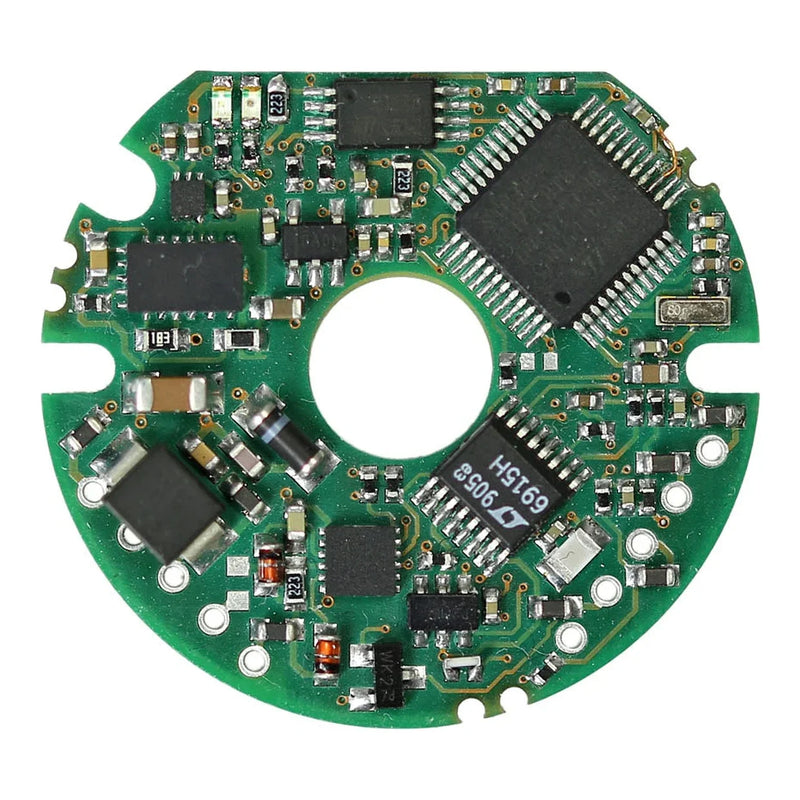
Strain gauge amplifiers as OEM boards
7 products
Showing 1 - 7 of 7 products
Strain gauge amplifiers as OEM boards. Amplifier boards for strain gauge full bridges, for installation in your own devices and sensors. If you order the board together with a load cell or force transducer, we mount, configure and calibrate both for you. You receive a finished measuring chain that displays in your unit and is documented with a certificate.
Strain gauge amplifiers as OEM boards: board and sensor as a finished unit
An amplifier board on its own is a semi-finished product. Several steps are needed before it produces a usable reading: mechanical mounting, wiring the bridge, setting the sensitivity range to the cell's sensitivity, zero adjustment, scaling to the rated load and finally a check with test weights.
We take care of these steps. If you order the board together with a load cell or force transducer, we supply the combination mounted, configured and calibrated. The sensor then shows kilograms or newtons, not millivolts, and you receive the corresponding certificate.
Why calibrating the chain is more accurate
Sensor and electronics each have their own deviations. If you calibrate them separately, these errors add up once assembled. The cell's non-linearity, the board's gain error and its zero offset all act on the same output value.
If, on the other hand, the chain is calibrated as a whole – the real combination of exactly this cell and exactly this board – only the remaining total error enters the result. In measurement terms this is the cleaner route, and in practice it usually gives considerably better accuracy than the sum of the individual data sheets would suggest. On request we calibrate to ISO 17025 in our own laboratory.
What this saves in your production
For series manufacturers, this is less a question of accuracy than of process.
Without this service, your own production needs an assembly station, an adjustment fixture with test weights, trained staff and a documented test step for each device. For small and medium quantities, this effort is out of all proportion to the benefit, and it ties up precisely the people you need elsewhere.
With a pre-assembled and calibrated measuring chain, this becomes a component with one item number. Goods receipt, installation, done. It also reduces the sources of error that typically occur in series production: swapped bridge wires, a wrongly set sensitivity range and a forgotten zero adjustment.
How ordering works
- Choose the sensor. Design and rated load from our range, or your special design from our custom manufacturing.
- Define the output signal. Which signal your control system or device expects.
- State the unit and measuring range. In which unit the full-scale value should be, and which value corresponds to the full-scale output.
- Describe the installation situation. Where the board should sit, how much installation space is available, what cable length is needed.
- We build, set up and calibrate. You receive the unit with a calibration certificate.
For recurring demand, we set up the configuration as a variant. Repeat orders then arrive with identical settings, without you having to state the parameters again.
What you should tell us
- Sensitivity of the cell in mV/V and bridge resistance, if you provide the sensor
- Rated load and required display range
- Output signal and supply voltage of your device
- Installation space and required mounting of the board
- Temperature range at the installation location of the electronics
- Quantity and planned annual demand
When the electronics should go into the sensor
If you need not a separate board but a sensor with electronics already integrated, that is also possible. The signal processing then sits in the sensor housing and you receive one device with one cable. For a digital connection you will find this under load cells with IO-Link; for analog signals we build it on request.
Conversely, if it is very hot at the installation location or the sensor itself has to remain particularly compact, a separate design with a remote board is the better route, because the electronics are then not exposed to the sensor environment.
Further options
If measurement takes place directly on the component instead of with a finished transducer, we bond the strain gauges and match the board and installation to each other. If no standard board meets your requirements, we develop the measuring electronics to your specifications.
General notes on selecting, documenting and integrating OEM assemblies can be found in the overview OEM boards and amplifier modules.
Send us your requirements and you will get a concrete proposal with price and delivery time.