Strain gauge bridge amplifiers with several measuring channels
3 products
Showing 1 - 3 of 3 products
Strain gauge bridge amplifiers with several measuring channels read two to six strain gauge bridges in one device. Each bridge remains a measuring channel of its own, with its own scaling and its own output – two measuring points, therefore, not one summed value.
Two channels or two cells on one channel
This distinction decides whether the setup will deliver the information you want. If several load cells are wired to one input, their signals add up: you get a total weight, but not the distribution. That is exactly right for a vessel scale and useless for load distribution.
If the measuring points are to stay separate – because you want to detect uneven loading, monitor two independent axes or watch two limits individually – every bridge needs its own channel. That is what the devices on this page are built for.
Monitoring two measuring points in a safety function
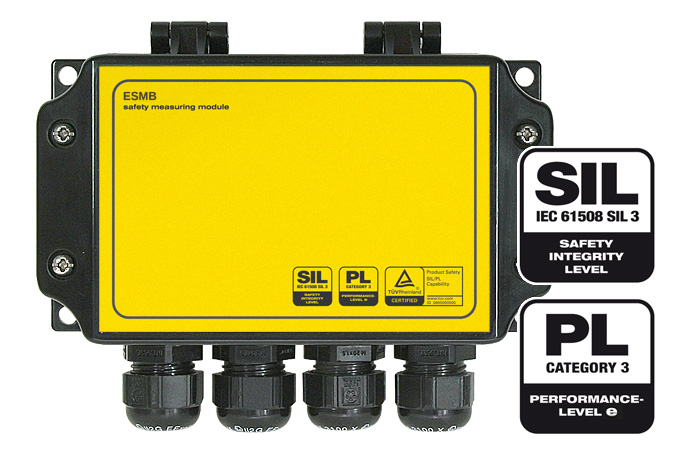
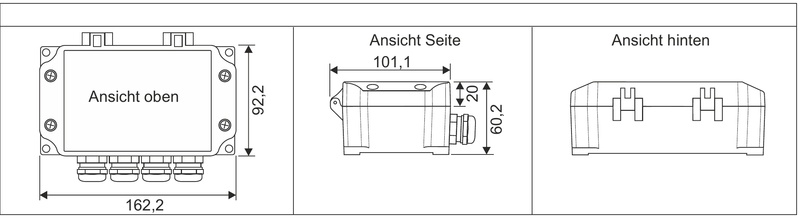
The ESMB sits in a field housing rated IP65 and is available with one or with two amplifiers in the same housing. In the two-bridge version, two measuring points are monitored independently of each other up to SIL3 and PL e category 3.
Each bridge signal goes to two galvanically isolated current outputs so that the safety controller can compare the two outputs of one channel against each other. With two bridges that makes four outputs for two measuring points. You choose the version with one or with two bridges as a variant.
Three or six channels for test bench and experiment
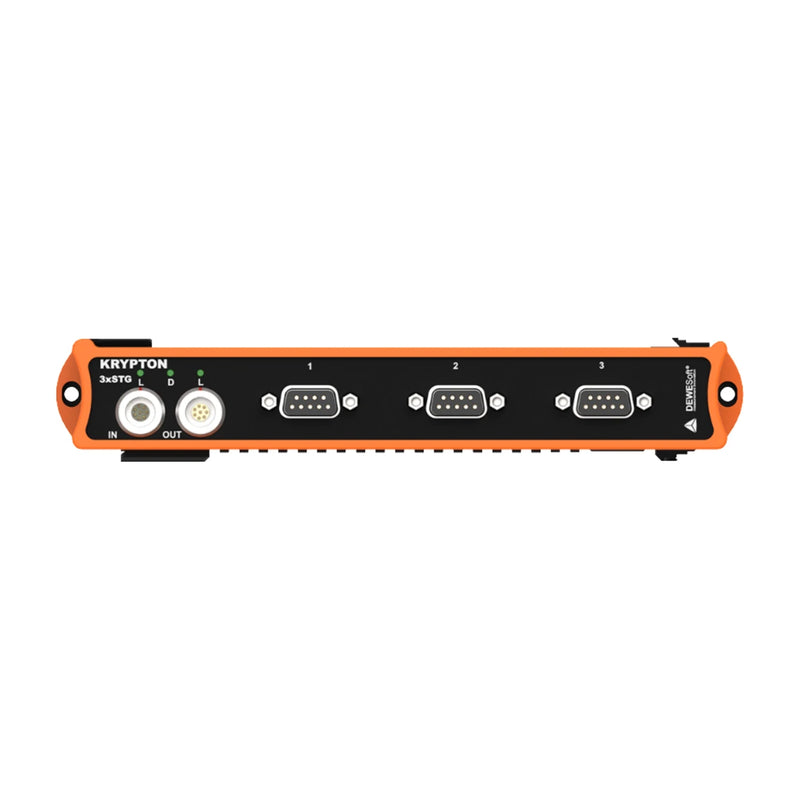
The EMDA with three and the EMDB with six channels sit in an aluminium block machined from solid and potted, IP67 from −40 to +85 °C. Each channel takes a full, half or quarter bridge – completion for 120 Ω and 350 Ω is built in – or a voltage, and is sampled with 24 bit at up to 20 kS/s, all channels simultaneously.
One cable carries data, power and synchronisation over EtherCAT: up to 100 m to the next unit, up to 64 units in a chain, all sampled to within less than one sample of each other. TEDS is read automatically. For a single channel of the same design there is the EMDC.
Process value or curve
The two designs solve different tasks. The ESMB is a process amplifier: it delivers a stable value per channel to the controller and is rated for a machine's protective function, but it does not record a curve. EMDA and EMDB are built for data acquisition: they sample time-synchronously at a high rate and run into a recording.
If you need the curve – the rise in force during assembly, the peak on impact, the phase relation between force and displacement – or if many channels carrying different quantities are to run synchronously into one recording, EMDA and EMDB are the right tool. Larger systems we put together to match your test setup; tell us the channel count, the quantities, the bridge type and the fastest change you need to capture.
Going further
If one measuring point is enough, the bridge amplifiers with one measuring channel lead to the cheaper device. Where weight and dosing with several cells are involved, the multi-channel weighing transmitters are the right branch. For several measuring points without cabling, the wireless telemetry systems sit alongside.