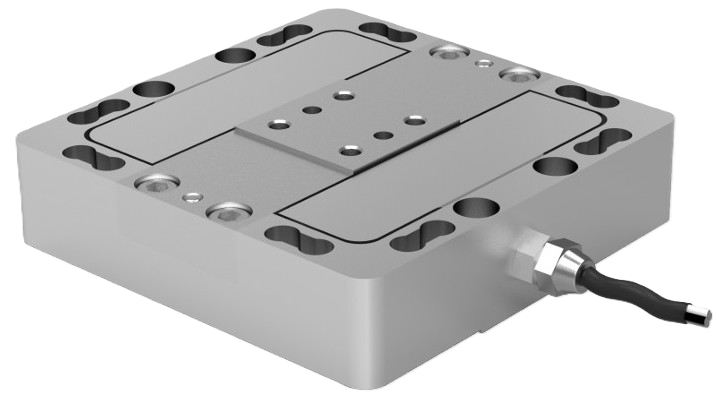
Multi-dimensional force transducers, 3-axis force sensors (3D)
1 product
Showing 1 - 1 of 1 product
Multi-dimensional force transducers 3-axis force sensors (3D) (also called multi-component force transducers or multi-axial force sensors) are sensors that can precisely capture forces and moments simultaneously in several axes (X, Y and Z). While conventional force transducers measure in only one direction (tension and/or compression), these sensors separate the applied loads electronically and mechanically by their direction of origin.
Multi-dimensional force transducers, 3-axis force sensors (3D)
In test and automation engineering, measuring in one direction is often not enough. Multi-dimensional – also called multi-axis or multi-component – force sensors capture forces (Fx, Fy, Fz) and moments (Mx, My, Mz) in up to six spatial directions simultaneously. One compact component thus replaces an assembly of several individual force transducers.
Multi-dimensional force transducers: capturing complex loads with one component
Subcategories
- 3-dimensional force sensors (3D), (also called 3-axis force sensors) – Fx, Fy and Fz simultaneously, 50 N to 5,000 N
- 6-axis force/torque sensor (6D) – in addition to the three forces, also measures the three moments (Mx, My and Mz) about these axes. This is the most versatile version.
- Custom multi-dimensional force transducers on request
Your benefits of multi-dimensional force transducers
- Compact and economical: saves installation space, weight, and both assembly and wiring effort
- Low crosstalk: mechanical decoupling of the axes keeps crosstalk between the channels small
- Proven technology: strain gauges in a Wheatstone full bridge, with long-term stability in industrial use
- Robust: aluminum, alloyed steel or stainless steel, protection rating IP68, version with ATEX certification available
Typical fields of application
- Robotics & automation: in robot arms (often at the wrist) for delicate assembly work, grinding, polishing or joining components without a camera.
- Medical technology & biomechanics: on gait analysis platforms for studying movement sequences, or in prostheses.
- Test rigs & research: in wind tunnels (to determine aerodynamic forces and moments on models) or on material and tire test rigs in the automotive industry.
- Aerospace: for structural monitoring and load analysis of components.
Each axis needs its own channel for signal processing: suitable devices can be found under strain gauge amplifiers and multi-channel weight transmitters. If you need a different design, a different number of axes or the moments as well, we build it – see custom force transducers or get in touch via Contact. Calibration to ISO 17025 in our own laboratory.