Weighing modules for load cells: silo, tank, container
30 products
Showing 25 - 30 of 30 products
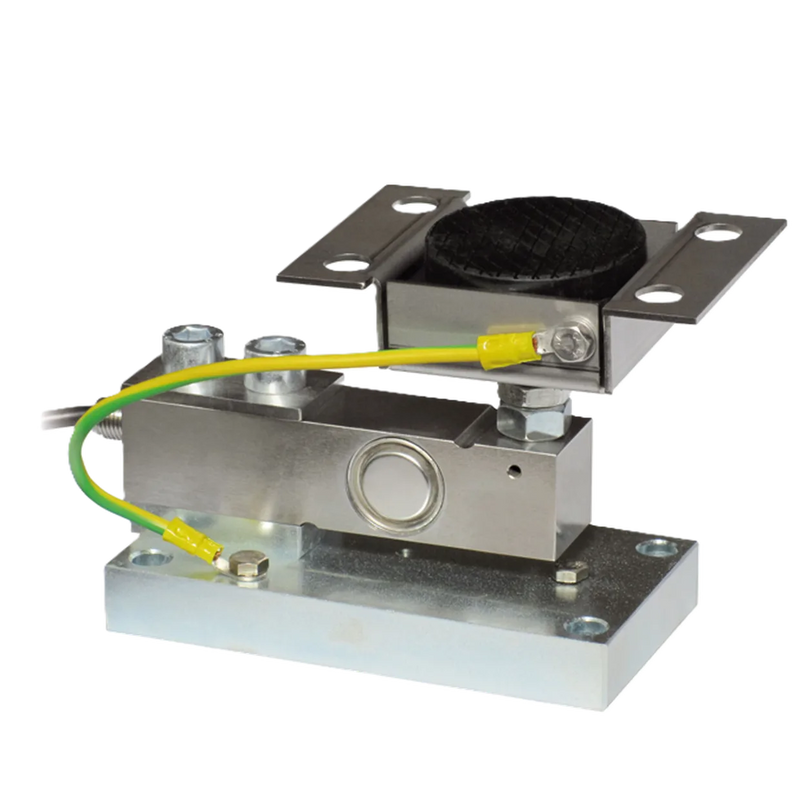
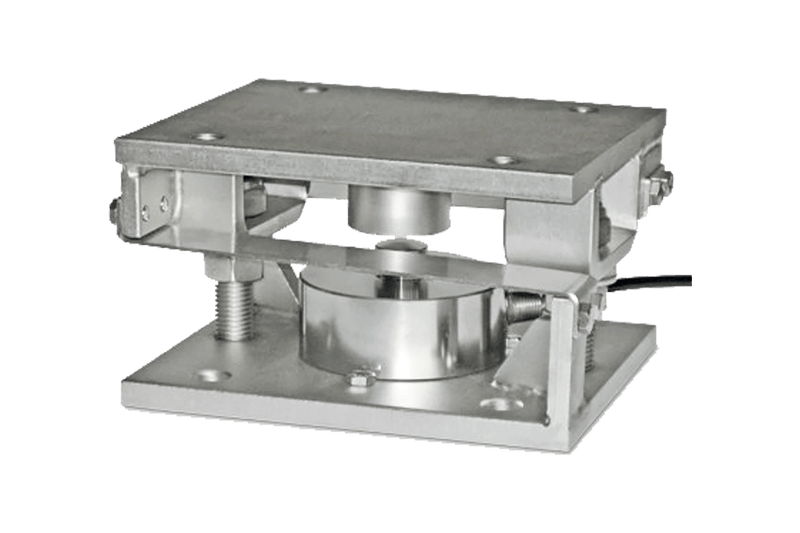
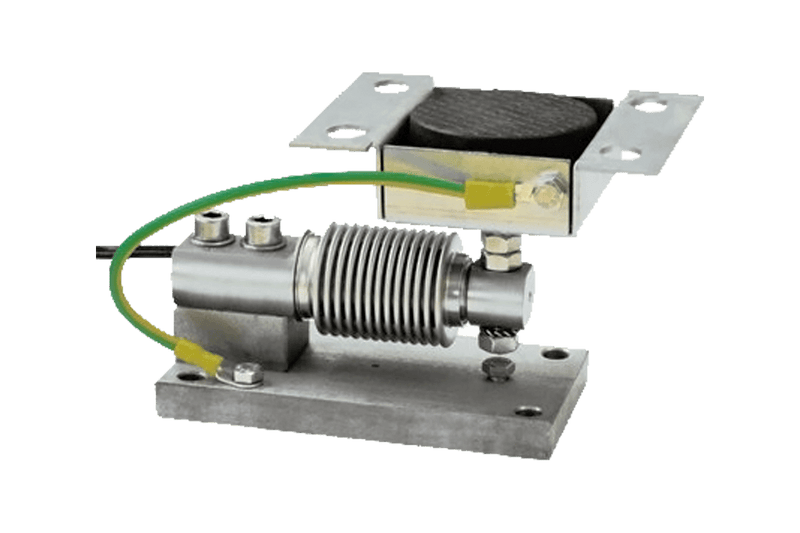
Load cell weighing modules are the installation kit between the silo, tank or container and the load cell. They transfer the load precisely into the cell, secure against tipping, lateral displacement and lifting, and tolerate the angular misalignment found in welded silo and tank constructions. Available in galvanized steel and AISI 304 stainless steel, for applications up to 100,000 kg per module, matching our load cell series.
Why a load cell is not installed without a weighing module
A compression load cell measures accurately when the load acts perpendicularly and centrally on its compression surface. In reality, however, a container is never ideally positioned: the construction is not exactly level, the silo expands thermally, wind and agitator start-up introduce lateral forces, and during emptying, one leg can even lift off.
A weighing module solves precisely these problems. The self-centering spherical joint ensures load transfer, even if the support surfaces are not parallel. The lateral restraint absorbs lateral forces without transmitting them in the measuring direction. The anti-lift device holds the container in place when it is empty or subjected to lateral loads. Where the installation height needs to be adjusted, the modules are height-adjustable.
Cells mounted without a module not only provide inaccurate readings but also fail prematurely because lateral forces and moments exceed permissible limits. The module price is small compared to the cell price; savings are made in the wrong place.
How many modules does your container need?
Three modules are the technically cleaner solution for round containers, tanks, and silos. Three support points are statically determined, the load is distributed evenly regardless of uneven ground, and no alignment is necessary.
Four modules are used for rectangular constructions and existing four-legged frames. They then require a flat installation surface, and the load distribution must be checked during installation, otherwise two points will bear significantly more load than the others.
To calculate the nominal load per module, sum the tare weight of the container plus the maximum filling quantity, divide by the number of modules, and add a reserve for unequal load distribution and dynamic components during filling. With unfavorable geometry or off-center discharge, one point can quickly bear significantly more than the calculated share. If you provide us with container dimensions, tare weight, and filling medium, we will calculate the design with you.
For large containers, costs can be saved by equipping only a portion of the support points with load cells, and the remaining ones with blind modules or spherical bearings. This is advisable if the load distribution is structurally fixed, but it comes at the cost of accuracy and should be calculated beforehand.
The module must match the load cell
Weighing modules are not universal parts. Each series is designed for specific cell series and their connection geometry. The assignment is listed in the datasheet for each item, and the CAD model is available for download so you can check the installation situation in advance.
As a guide to the range:
- T8 for applications up to 300 kg, galvanized steel, suitable for series L-AZLI, L-AZL, L-AZS, and L-AM
- TFCPV and TFCPVZ up to 300 kg, in AISI 304 stainless steel or galvanized steel, for series L-FCOL and L-FCK
- PV and PVZ up to 2,000 kg, stainless steel or galvanized steel, for series L-FTK, FTKL, L-FTP, FT-P, and FTZ
- V-series for higher load ranges in silo and tank applications
- Spherical joints as individual parts, if only the force introduction needs to be supplemented
If no standard design suits your construction, we manufacture adapter plates and special designs; contact us about customer-specific solutions.
The most common installation error: piping
In practice, most measuring errors in tank scales do not originate from the cell or the module, but from rigid connections. Every rigidly screwed pipe, every stiff line, and every welded-on web diverts forces away from the weighing system and distorts the result, often temperature-dependent and thus difficult to locate.
Therefore, keep pipe connections as flexible and as horizontal as possible, route cables and hoses with a loop instead of being taut, and refrain from adding additional struts after installation. After installation, check that the container rests freely on the modules.
Evaluation and Calibration
The signals from multiple cells are combined in a summing box and evaluated by a weighing transmitter or weighing indicator, from there onwards to 4…20 mA, IO-Link or fieldbus. Because the actual accuracy of a tank scale depends on the construction and not just the cell, calibration on the installed system is recommended. For the cells themselves, we calibrate according to ISO 17025 in our own laboratory.
Matching Products and Alternatives
You can find suitable cells under compression load cells and button load cells, and further installation accessories in the load cell accessories section. If the container rests on machine feet, load cell feet are the simpler retrofit solution.
If you are only concerned with the fill level and not the weight, gravimetric measurement via weighing modules is media-independent and possible without installation in the container, but it is more elaborate than level measurement with radar or hydrostatics. However, for bulk solids with bridging or changing density, weighing plays to its advantage because it directly measures mass.
Price, datasheet, and CAD model are available online for each item. Our engineers will directly advise you on the design of module quantity, nominal load, and installation.